
What is freelancing? Learn how freelancing works, the main types, pros and cons, realistic earnings, and how to start your first gig in 30 days.
You’ve probably seen people online saying they “quit their 9-to-5 to freelance,” and you may already have a skill someone would pay for. What most of those posts leave out is how freelancing actually works day to day: how clients are found, how pricing works, and what happens with taxes and slow months. In this guide, we’ll explain exactly what freelancing is, how it works, the types of work you can do, its real pros and cons, and the practical steps to land your first client.
Key Takeaways
- Freelancing is a form of self-employment in which a person sells skills or services to multiple clients on a project, hourly, or retainer basis instead of working for a single employer.
- Freelancers handle their own client acquisition, pricing, contracts, invoicing, and taxes. That makes freelancing closer to running a small business than holding a job.
- Common freelancing fields include writing, graphic design, web development, digital marketing, video editing, virtual assistance, and consulting.
- Freelancing offers flexibility, location independence, and uncapped earning potential. It also comes with irregular income, no employer-paid benefits, and self-employment taxes.
- Freelancers find work through online marketplaces such as Upwork and Fiverr, professional networks such as LinkedIn, referrals, and direct outreach.
- Beginners can start freelancing by choosing one marketable skill, building a small portfolio, setting a clear rate, and pitching consistently to targeted clients.
- Freelancer earnings vary widely by skill, niche, experience, and location, so realistic income goals should be based on market rates rather than headline success stories.
What Is Freelancing?
Freelancing is a form of self-employment in which an individual offers skills or services to multiple clients on a per-project, hourly, or retainer basis, rather than working as a salaried employee for a single company. Freelancers choose their clients, set their own rates, and decide how and when the work gets done.
Interestingly, the term has medieval roots. A “free lance” was a mercenary knight whose lance was not pledged to any single lord, so he could fight for whoever hired him. Today the idea is the same, but the weapon is a skill like writing, coding, or design.
What Is a Freelancer?
A freelancer is a self-employed professional who is hired by clients for specific projects and is responsible for finding work, setting rates, invoicing, and paying their own taxes. The person or business paying for the work is called the client. Unlike an employer, a client does not provide a salary, training, or benefits.
For example, a freelance graphic designer might create a logo for a bakery in Texas on Monday. On Wednesday, the same designer might start social media templates for a fitness coach in London. Each client pays per project, and neither one is the designer’s “boss.”
Is Freelancing a Real Job or Just a Side Hustle?
Simply put, freelancing can be either one, depending on how much time you commit. Freelancing is a legitimate business model, and it works at every level, from a few hours a week to a full-time agency. Later in this guide, we’ll break down this “freelancing spectrum” so you can see where you might fit.
Why Does Freelancing Matter Today?
Freelancing matters because a large and growing share of the workforce now earns income independently, and companies increasingly rely on freelancers for specialized, flexible talent. It is no longer a fringe arrangement. It is a core part of how modern work gets done.
To begin with, the numbers are significant:
- 64 million Americans did freelance work in 2023, representing 38% of the U.S. workforce — Source: Upwork Freelance Forward, 2023
- Freelancers contributed roughly $1.27 trillion in annual earnings to the U.S. economy — Source: Upwork Freelance Forward, 2023
- Skilled U.S. freelancers earned a combined $1.5 trillion in 2024 — Source: Upwork Future Workforce Index, 2025
- Between 154 million and 435 million people worldwide do online gig and freelance work — Source: World Bank, Working Without Borders, 2023
In addition, remote work and AI tools have lowered the barriers to entry. For example, a beginner with a laptop can now use free tools to write, design, and edit at a professional level and sell that work to clients anywhere. That shift is one reason freelancing ranks among the most popular legit ways to make money online
Why do freelancer statistics vary so much? You may see claims that 1.57 billion people freelance worldwide. That figure comes from ILO data on all self-employed workers, including subsistence farmers and informal market traders. It is not a count of online freelancers. Different studies use different definitions, which is why trustworthy guides always name their source.
How Does Freelancing Work?
Freelancing involves choosing a marketable skill, finding clients through platforms or networking, agreeing on project scope and pricing, delivering the work, and invoicing the client for payment. Every freelance project, big or small, follows roughly the same lifecycle.
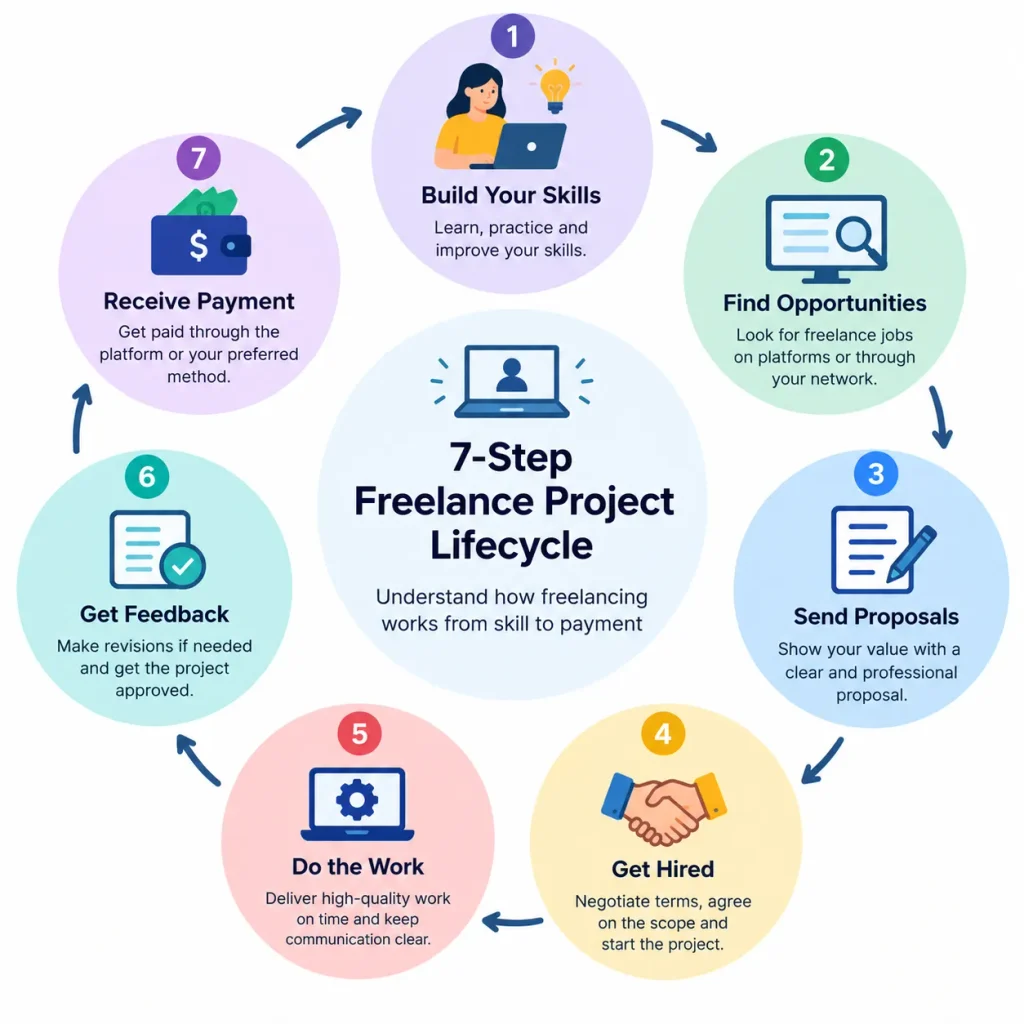
The Freelance Project Lifecycle
Here is the typical sequence most freelancers follow:
- Choose a skill or service. Pick something specific, such as SEO blog writing or Shopify store setup.
- Build a portfolio. Create 3–5 samples that show clients what you can do.
- Find clients. Use marketplaces, referrals, cold email, or social media.
- Send a proposal. Explain how you’ll solve the client’s problem.
- Sign a contract. Agree on scope, deadlines, revisions, and payment terms in writing.
- Deliver the work. Meet the deadline and communicate clearly throughout.
- Invoice and get paid. Send an invoice, then follow up if payment is late.
How Do Freelancers Find Clients?
Most beginners start on online marketplaces because clients there are already looking to hire. That being said, experienced freelancers often get most of their work from referrals and repeat clients. For example, one happy client who refers two friends can be worth more than 20 cold proposals.
How Do Freelancers Set Their Rates?
Freelancers typically use one of four pricing models:
- Hourly: You’re paid for time worked, such as $35/hour for virtual assistance.
- Fixed-price: You’re paid one amount per project, such as $500 for a five-page website.
- Retainer: The client pays a monthly fee for ongoing work, such as $1,200/month for social media management.
- Value-based: Your price is tied to the result you deliver, which is common in consulting and conversion copywriting.
What Are the Main Types of Freelancing?
Freelancing can be classified by commitment level and by skill category. Understanding both helps you decide how to start and what to offer.
The Freelancing Spectrum: From Side Hustle to Agency
First, consider how much time you want to invest:
- Side freelancing: A few hours a week alongside a full-time job.
- Part-time freelancing: 15–30 hours a week, often while studying or parenting.
- Full-time freelancing: Freelancing is your main income source.
- Freelance agency: You hire or subcontract other freelancers to take on bigger projects.
What Are the Most In-Demand Freelancing Skills in 2026?
Next, pick a skill category. The table below shows popular options with example tasks.
| Skill Category | Example Freelance Task |
|---|---|
| Writing & content | Write a 1,500-word blog post for a SaaS company |
| Graphic design | Design a logo and brand kit for a startup |
| Web & software development | Build a WordPress site or fix app bugs |
| Digital marketing & SEO | Run Google Ads or audit a website’s SEO |
| Video editing | Edit YouTube videos or short-form reels |
| Virtual assistance | Manage a client’s inbox, calendar, and bookings |
| Data & AI work | Clean datasets or build AI automation workflows |
| Consulting | Advise a small business on operations or finance |
How Is Freelancing Different from Full-Time Employment and Gig Work?
The main difference between freelancing and full-time employment is that freelancers work independently for multiple clients without employer-provided benefits, while employees work for one employer and receive a regular salary and benefits. Gig work, such as rideshare driving or food delivery, is related to freelancing but distinct from it. Gig workers usually perform standardized tasks at prices set by an app, while freelancers sell specialized skills and set their own rates.
| Factor | Freelancing | Full-Time Job | Gig Work |
|---|---|---|---|
| Income stability | Variable | Stable salary | Variable, task-based |
| Benefits | None (self-funded) | Usually included | Rarely included |
| Control over work | High | Low to moderate | Low (app sets rules) |
| Taxes | Self-employment tax | Withheld by employer | Self-employment tax |
| Client relationships | Direct, long-term possible | One employer | Mostly anonymous |
| Growth ceiling | Uncapped | Tied to promotions | Limited by hours |
Plus, freelancing isn’t the only flexible online income model. Some people pair it with content-based income, which you can explore in our guide to affiliate marketing for beginners
What Are the Pros and Cons of Freelancing?
Freelancing gives you freedom and earning potential, but it shifts every business risk onto you. Successful freelancers go in with both sides of that trade-off in mind.
Advantages of Freelancing
- Flexibility: You set your own schedule.
- Location independence: You can work from anywhere with an internet connection.
- Uncapped earning potential: Your income grows with your rates and client base.
- Client choice: You can decline projects that don’t fit.
- Skill growth: Varied projects build experience quickly.
What Nobody Tells You: The Real Disadvantages
Honestly, the downsides are real. Income is often “feast or famine”, meaning a busy month can be followed by a quiet one. Moreover, you pay for your own health insurance, retirement savings, and equipment, and platform fees reduce what you take home.
Do Freelancers Have to Pay Taxes?
Yes. In the United States, freelancers pay self-employment tax on top of income tax.
- Self-employment tax is 15.3%, covering Social Security and Medicare — Source: IRS, 2026
As such, many freelancers set aside 25–30% of every payment for taxes.
How Much Do Freelancers Earn?
Freelancer earnings depend on skill, niche, experience, location, and whether clients come through platforms or directly. There is no single “average” income that applies to everyone.
- The worldwide average freelance rate was about $28 per hour in a survey of over 2,000 freelancers across 122 countries — Source: Payoneer Global Freelancer Income Report, 2022
For example, a beginner writer might charge $0.05–$0.08 per word, while an experienced SEO consultant could charge $100+ per hour. Similarly, freelancers who land direct clients usually keep more than those paying platform fees.
What Tools and Platforms Do Freelancers Use?
Freelancers rely on a small stack of tools to find clients, manage projects, sign contracts, and get paid. Every task below has free or low-cost options, so you don’t need a big budget to start.
Freelance Marketplaces
To find clients, start with marketplaces like Upwork, Fiverr, Freelancer.com, and Toptal (for vetted experts). Also use LinkedIn, which works as a free networking alternative.
Payment and Invoicing Tools
For international clients, freelancers commonly use PayPal, Wise, Payoneer, and Stripe. Free invoicing apps or simple Google Docs templates work fine early on.
Productivity and Contract Tools
For staying organized, use Trello or Notion for project boards, Google Workspace for documents, Canva for visuals, and a time tracker such as Toggl. AI assistants can speed up drafting and research. Free e-signature tools can handle contracts.
How Can You Start Freelancing in 30 Days?
You can start freelancing within 30 days by focusing on one skill, a small portfolio, and consistent outreach. Here’s a realistic plan:
- Week 1: Pick one marketable skill you can already deliver at a basic professional level.
- Week 1–2: Build three portfolio samples. Use mock projects if you have no clients yet.
- Week 2: Set a starting rate based on market research, not guesswork.
- Week 2: Create one or two platform profiles, such as Upwork and LinkedIn.
- Weeks 3–4: Send 5–10 tailored proposals per week. Personalize every one.
- From your first payment: Set aside 25–30% for taxes.
- Ongoing: Track every client, invoice, and deadline in a simple spreadsheet.
By following this plan consistently, you can realistically land your first paying client within a month. Expect results to vary by skill and effort.
Conclusion
Freelancing is self-employment where you sell your skills to multiple clients on your own terms. It offers real freedom and income potential, but it also demands business discipline around clients, pricing, and taxes.
Ultimately, freelancing isn’t a shortcut to easy money. It’s a business you build one client at a time. Start small, stay consistent, and treat it like a business from day one. Your first client is closer than you think.
Disclaimer: I use AI tools to help outline and draft my guides. I check every fact against the official source linked in the article, and the opinions are my own. — Zee

1 thought on “What Is Freelancing? The Complete Beginner’s Guide to How It Works, What It Pays, and How to Start”