
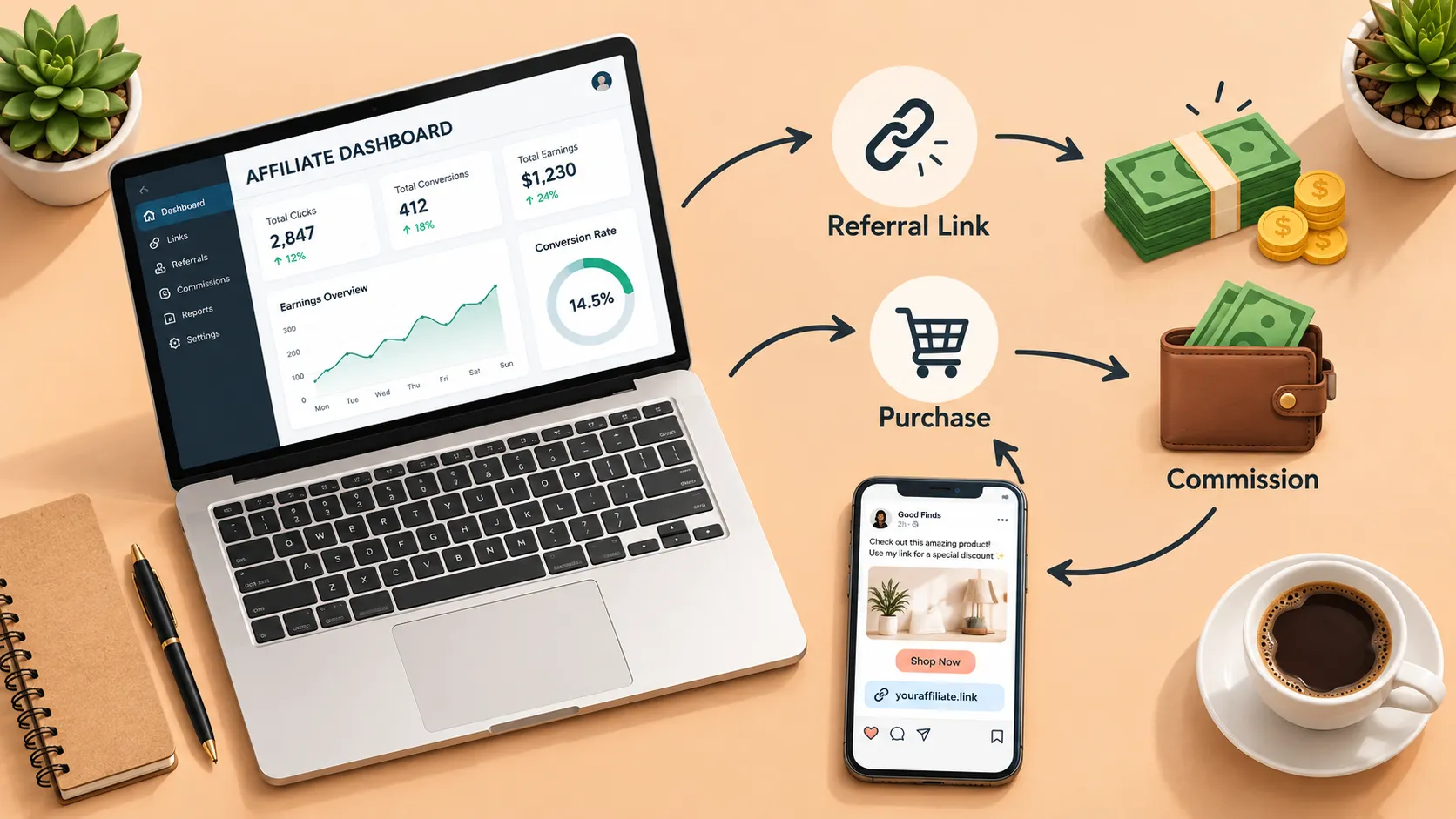
Learn how to start affiliate marketing with no money in 2026: free platforms, free programs, $0 tools, FTC disclosure rules, and a 30-day action plan.
You’ve probably seen creators bragging about passive income from affiliate links and wondered whether it’s possible without a budget for websites, ads, or courses. What most of those videos skip is that the people who succeed aren’t the ones who spent the most money—they’re the ones who picked the right free platform, joined the right programs, and published consistently. In this guide, you’ll get a step-by-step roadmap to start affiliate marketing with $0, including the exact free tools, beginner-friendly programs, and a 30-day action plan to earn your first commission.
Key Takeaways
- Affiliate marketing is a performance-based business model in which you earn a commission for promoting another company’s products through a unique tracking link.
- Starting costs can be zero because most major affiliate programs are free to join and many content platforms (YouTube, Pinterest, TikTok, Medium) are free to use.
- Niche selection is the most important early decision; the best beginner niches combine personal interest, a clear audience problem, and products that pay meaningful commissions.
- Free traffic comes from SEO, short-form video, Pinterest, and helpful community participation, but it typically takes 3–6 months of consistent publishing to generate steady commissions.
- Value-first content such as honest reviews, comparisons, and tutorials converts better than posting affiliate links without context.
- Affiliate disclosures are legally required in many countries, including under the U.S. FTC Endorsement Guides, and must be clear and placed before the affiliate link.
- First commissions should be reinvested into growth tools, such as a custom domain or email software, rather than spending money before earning any.
What Is Affiliate Marketing and How Does It Work?
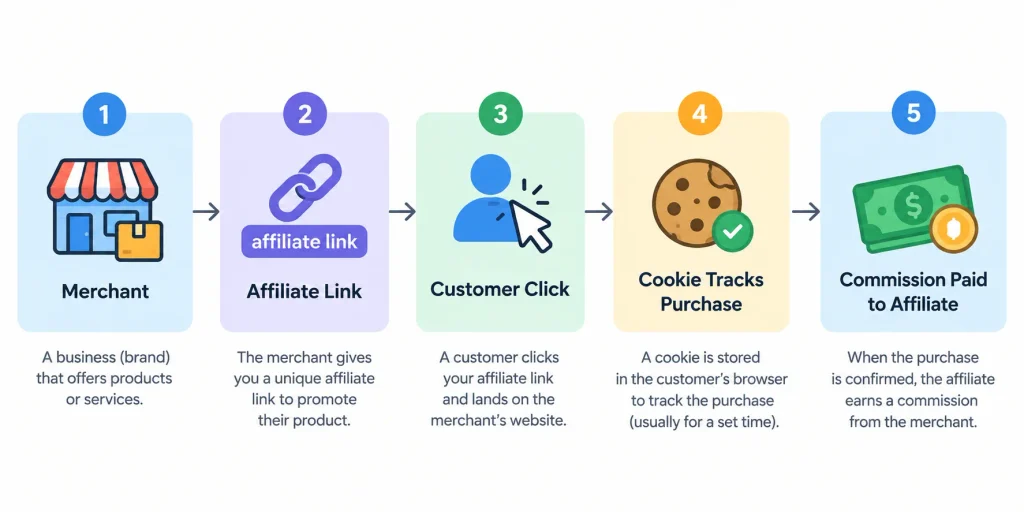
Affiliate marketing is a performance-based marketing model in which a person earns a commission by promoting another company’s products or services through a unique tracking link. In other words, you recommend, a customer buys, and the brand pays you a share. For example, if you recommend a $60 desk lamp at a 4% rate, you earn $2.40 per sale.
To put it simply, four parties make the system work:
- Merchant: the brand that sells the product (e.g., a laptop-stand maker).
- Affiliate: you, the person creating content and sharing links.
- Customer: the reader or viewer who clicks and buys.
- Network: the platform that tracks sales and pays you (e.g., Awin, Impact, ClickBank).
An affiliate link is a unique URL containing a tracking ID that tells the merchant which affiliate referred a sale, so the correct commission can be credited. Moreover, a cookie stores that referral for a set window. For example, Amazon credits you for qualifying items added to the cart within 24 hours of the click, while many digital-product networks use far longer windows.
Can You Really Start Affiliate Marketing With No Money?
Yes—affiliate marketing is one of the few online businesses you can start for $0, because joining programs and publishing on free platforms costs nothing. Unlike e-commerce, you hold no inventory, create no product, and handle no customer service. For example, a student can join ClickBank, film product tutorials on a phone, and post them to YouTube Shorts without spending a cent.
Furthermore, the money in this channel is growing, not shrinking:
- US advertisers are forecast to spend $13.81 billion on affiliate marketing in 2026, up 11.3% from 2025 — Source: [EMARKETER, 2025]
- Affiliate marketing is forecast to drive $241.03 billion in US e-commerce sales in 2026 — Source: [EMARKETER, 2025]
- The global affiliate market was valued at $18.51 billion (USD 18,512.2 million) in 2024 — Source: [Cognitive Market Research, Affiliate Market Report, 2024]
- Over 80% of advertisers and 84% of publishers surveyed ran an affiliate program, according to a Rakuten-commissioned Forrester Consulting study cited by Influencer Marketing Hub — Source: [Influencer Marketing Hub, 2023]
That being said, note that these figures measure different things. EMARKETER tracks US advertiser spend, while Cognitive Market Research estimates global industry value, so never add them together.
Step 1: How Do You Choose a Profitable Affiliate Marketing Niche for Free?
A profitable affiliate niche is a specific topic where your interest, a clear audience problem, and well-paying products overlap. Think “budget home-office gear for remote workers,” not “technology.” For example, a narrow niche lets a brand-new creator rank and get noticed faster than a broad one.
Use the 3P Test: Passion, Problem, Profitability
First, list five topics you could discuss for a year. Next, confirm each has a real problem people search for, such as back pain from bad chairs. Finally, check that programs pay meaningful commissions. For example, Amazon’s US commission statement lists 4.5% for physical books, kitchen, and automotive, 3% for toys, furniture, home, and tools, and just 1% for grocery and health, while digital products on ClickBank or Digistore24 often pay 50%–75%.
Validate Demand With Free Tools
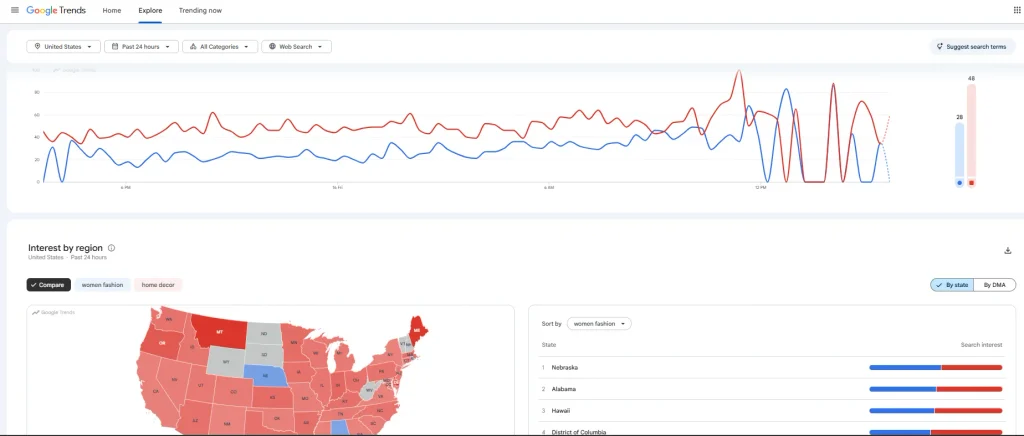
Next, test your idea before you publish anything. Google Trends shows whether interest is rising or fading over five years. For example, comparing “standing desk” with “laptop stand” reveals which term holds steadier demand.
Then, use AnswerThePublic to surface real questions; its free account allows 3 searches per day. Additionally, scan Reddit threads and Amazon Best Sellers to see what people actually buy and complain about.
Step 2: Which Free Platforms Are Best for Affiliate Marketing Beginners?
The best free platforms for affiliate beginners are YouTube, Pinterest, short-form video (TikTok and Instagram Reels), Medium, and a free blog, chosen by how your audience likes to consume content. For example, visual home-décor shoppers live on Pinterest, while gadget buyers watch YouTube reviews.
Can You Do Affiliate Marketing Without a Website?
Yes—affiliate marketing without a website is realistic in 2026. Here are the key platform rules to know:
- YouTube: You can add affiliate links to descriptions at any size. YouTube’s own Shopping affiliate program now requires YouTube Partner Program membership and at least 500 subscribers (lowered in March 2026).
- TikTok: TikTok Shop’s US affiliate program requires 18+ and at least 1,000 followers; accounts under 5,000 enter a 30-day pilot with limits.
- Pinterest: Affiliate links are allowed if you’re transparent, use one authentic account, and disclose (e.g., #ad or the paid-partnership label).
- Medium: Affiliate links are allowed with disclosure, but third-party sponsorships are not.
- WordPress.com: Affiliate links are allowed when your site’s main purpose is original content, not funneling traffic.
Free Traffic Channel Comparison
Consequently, choose one primary channel based on this comparison:
| Channel | Cost | Time to First Traffic | Content Lifespan | Best For |
|---|---|---|---|---|
| Free blog (WordPress.com, Medium) | $0 | 3–6+ months (SEO) | Years | Reviews, “best X for Y” |
| YouTube (long + Shorts) | $0 | Weeks to months | Months to years | Tutorials, demos |
| Short-form social (TikTok, Reels) | $0 | Days | Days to weeks | Trend-driven products |
| $0 | 1–3 months | Months | Home, décor, DIY, fashion |
Step 3: What Are the Best Free Affiliate Programs for Beginners to Join?
The best free affiliate programs for beginners are Amazon Associates, Awin, Impact, CJ Affiliate, ClickBank, Digistore24, and SaaS programs with recurring commissions. For example, a productivity creator might pair Amazon (for desks) with a SaaS tool (for software).
| Program | Cost to Join | Typical Commission | Key Beginner Rule |
|---|---|---|---|
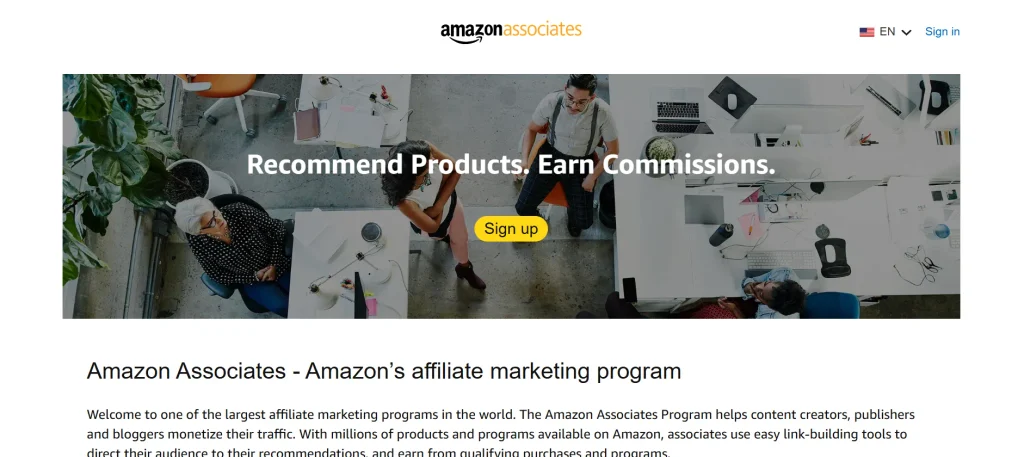
| Amazon Associates | Free | ~1%–10% (20% Amazon Games) | 3 qualifying sales in 180 days |
| Awin (absorbed ShareASale) | Small refundable deposit | Varies by brand | Each brand approves you separately |
| Impact | Free | Varies; many recurring | Social channels can be verified as properties |
| CJ Affiliate | Free | Varies by brand | Website is the safest route to approval |
| ClickBank | Free | Often 50%–75% | No approval; digital products |
| Digistore24 | Free | Typically 50%–75%, up to 100% | No approval needed |
Program Notes That Save You Headaches
Read the Amazon Associates rules because missing the 180-day sales window closes your account. Moreover, ShareASale shut down on October 6, 2025, and its merchants moved to Awin, whose US FAQ lists a $1 deposit refunded once you hit your first payment threshold. Finally, digital marketplaces pay high rates but carry quality risks, so vet products carefully.
Step 4: What Type of Content Converts Best for Affiliate Marketing?
The content that converts best for affiliate marketing is buyer-intent content: honest reviews, comparisons, tutorials, and “best X for Y” roundups. These formats catch people who are already ready to buy. For example, “best budget office chair for back pain” attracts shoppers, whereas “history of office chairs” attracts browsers.
Additionally, show proof of use with photos, pros and cons, and who should not buy. Meanwhile, AI writing assistants can help you outline or edit, but your first-hand testing and opinions are what earn trust, so never publish unedited AI text or fake experience.
Step 5: How Do You Get Free Traffic to Your Affiliate Links?
Free traffic for affiliate links comes from search engines, short-form video, Pinterest, community participation, and your own email list. For example, one evergreen pin or ranking article can send visitors for months without new effort.
- SEO: Target long-tail questions and track results in free Google Search Console.
- Short-form video: Edit for free in CapCut and repurpose one clip across Shorts, TikTok, and Reels.
- Pinterest: Design vertical pins in Canva free and link them to helpful posts.
- Communities: Answer questions on Reddit and Quora, and follow each community’s self-promotion rules.
- Email: Kit’s free plan allows up to 10,000 subscribers, while MailerLite’s free plan dropped to 250 subscribers and 2,500 emails per month on June 16, 2026.
Step 6: Do You Need to Disclose Affiliate Links?
Yes—you must disclose affiliate links, because the FTC requires a “clear and conspicuous” disclosure of any material connection, and the UK’s ASA treats affiliate content as advertising. The FTC’s 2023 Endorsement Guides define clear and conspicuous as “difficult to miss” and easily understood. For example, the FTC suggests wording like “I get commissions for purchases made through links in this post.”
Moreover, place disclosures before the link, not at the bottom. In the UK, the ASA recommends a prominent “#ad” upfront and says “#aff” alone is unlikely to be understood. Furthermore, the FTC’s Consumer Reviews and Testimonials Rule (16 CFR Part 465), announced August 14, 2024 and in effect since October 21, 2024, bans fake reviews and lets the agency seek civil penalties against knowing violators, currently up to $53,088 per violation after the FTC’s 2025 inflation adjustment — Source: [FTC, 2024].
Sadly, most creators still get this wrong. In a Princeton study of roughly 500,000 YouTube videos and 2.1 million Pinterest pins, only 10.49% of affiliate marketing videos and 7.03% of affiliate pins disclosed their affiliate links — Source: [Mathur, Narayanan & Chetty, Princeton University, ACM CSCW 2018].
Track and Optimize for Free
Next, measure what converts. Use your network dashboard first, then Linktree’s free plan (unlimited links) for link-in-bio pages; Bitly’s free plan now allows only 5 short links per month. Avoid shortening or cloaking Amazon links, which Amazon restricts. Finally, double down on the posts that earn clicks and sales.
What Affiliate Marketing Scams Should Beginners Avoid?
Affiliate marketing scams are schemes that promise fast income while charging you money or harming your reputation. For example, a “done-for-you $500/day system” that costs $997 is a classic trap. Use this red-flags checklist:
- ☐ The program charges a large fee to join (legitimate networks are free or use small refundable deposits).
- ☐ Income claims show screenshots but no timelines or average results.
- ☐ You’re told to spam links in comments, DMs, or groups.
- ☐ The product has poor reviews or high refund complaints.
- ☐ You’re pressured to recruit others rather than sell products.
- ☐ You’re told you’ll quit your job in 30 days.
How Long Does It Take to Make Your First Affiliate Commission?
Most beginners earn a first commission within a few weeks to a few months, but steady income usually takes 3–6 months or longer of consistent publishing. For example, a TikTok video can sell a product within days, while a blog post may need months to rank.
How Much Can Beginners Realistically Earn From Affiliate Marketing?
Honestly, most affiliates earn modest amounts. 57.55% of surveyed affiliate marketers earned less than $10,000 per year — Source: [Influencer Marketing Hub, 2022]. Meanwhile, the opportunity on the brand side is real: 74% of brands generate 11%–30% of their total revenue from affiliate marketing — Source: [impact.com, 2025]. Therefore, reinvest your first $50–$100 into a custom domain or email upgrade only after you’ve earned it.
The $0 Starter Stack and a Worked Example
The $0 starter stack is a set of free tools that covers research, creation, publishing, links, and email.
| Task | Free Tool | Free-Tier Note | Alternative |
|---|---|---|---|
| Niche research | Google Trends | Free | Reddit search |
| Question research | AnswerThePublic | 3 searches/day | “People also ask” |
| Design | Canva | Free plan | Adobe Express |
| Video editing | CapCut | Free plan | YouTube Shorts editor |
| SEO tracking | Google Search Console | Free | Bing Webmaster Tools |
| Link-in-bio | Linktree | Unlimited links | Beacons |
| Kit | Up to 10,000 subscribers | MailerLite (250) |
Worked Example: Budget Home-Office Gear on Pinterest + YouTube Shorts
Here’s a hypothetical example, imagine Priya, a remote worker in Lagos or Manila. First, she validates “budget home office setup” in Google Trends and finds steady interest. Next, she joins Amazon Associates and Impact. Then, she films 30-second Shorts like “3 desk upgrades under $30” with a disclosed link in the description. Finally, she creates Canva pins linking to a free Medium roundup. If one $45 laptop stand sells at a 3% rate, she earns about $1.35—small, but it proves the system and counts toward Amazon’s three-sale requirement.
What’s Next? Your 30-Day Action Plan
A 30-day action plan is a week-by-week checklist that turns this guide into published content and live links.
- Week 1 – Research: Pick your niche with the 3P Test; validate with Google Trends and AnswerThePublic.
- Week 2 – Setup: Create your free channel; join 2–3 programs; write your disclosure.
- Week 3 – Publish: Post 5–7 buyer-intent pieces (reviews, comparisons, tutorials).
- Week 4 – Promote and measure: Share pins, Shorts, and helpful community answers; review clicks and double down.
Looking for more ways to earn without spending? Browse our recent post on Scholaronline.
Conclusion: Consistency Beats Capital
Starting affiliate marketing with no money involves choosing a niche, creating content on a free platform such as YouTube, Pinterest, or Medium, joining free affiliate programs, and driving free organic traffic to your affiliate links. Most importantly, disclose honestly, recommend only products you trust, and reinvest only after you earn. Consistency beats capital—start today with what you have, and publish your first piece this week.
Written by [Zee]
Disclaimer: This article was initially drafted using AI assistance. However, the content has undergone thorough revisions, editing, and fact-checking by human editors and subject matter experts to ensure accuracy.

4 thoughts on “How to Start Affiliate Marketing With No Money”